


Nature - 2019 July - Vol 570 No 7762
Publisher: Nature
Format: Paperback
ISBN: 9770028083095
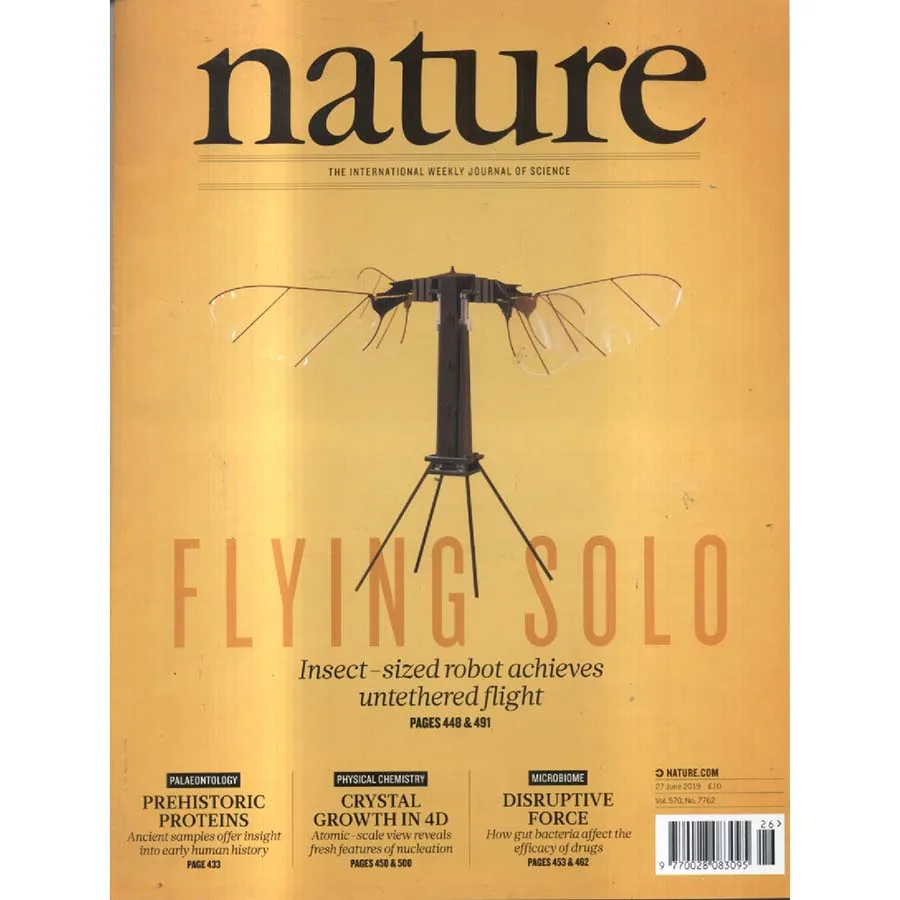
There are magazines that cautiously speculate about the future. Nature – June 2019, Vol. 570 No. 7762 instead places a tiny flying robot on the cover beneath the words “FLYING SOLO” and calmly informs readers that insect-sized machines have now achieved untethered flight. Which is exactly the sort of sentence that should probably come with at least a small advisory note.
The cover image is wonderfully minimalist and faintly sinister: a delicate mechanical insect hovering against a warm golden background like the prototype of something that will either save agriculture or eventually monitor humanity from the corner of the ceiling. By 2019, science had apparently decided that regular-sized robots were insufficiently ambitious and moved directly into the realm of autonomous robotic insects.
The lead feature concerns an insect-sized robot achieving untethered flight, which sounds charmingly technical until you realise this means humanity is actively recreating one of evolution’s most complicated engineering achievements at miniature scale. Somewhere inside this issue are researchers solving problems involving aerodynamics, power systems, control mechanics, and materials science, all so a machine the size of a bug can flap around independently like a tiny overachieving nightmare.
And naturally, because this is Nature, the issue immediately broadens into a sweeping tour of entirely different scientific frontiers. There are prehistoric proteins revealing clues about early human history, atomic-scale studies of crystal growth in four dimensions, and investigations into how gut bacteria influence the effectiveness of drugs. In classic Nature fashion, readers are expected to move seamlessly from robo-insects to ancient biomolecules without emotional difficulty.
The “Prehistoric Proteins” feature is especially wonderful because modern science has now reached the stage where even fragments of ancient tissue are being interrogated for evolutionary secrets. Humanity is no longer merely digging up bones; it is effectively performing forensic molecular archaeology across deep time.
Meanwhile, the microbiome article quietly continues the late-2010s scientific tradition of discovering that gut bacteria are somehow involved in absolutely everything. At this point, one half expects future issues of Nature to reveal that intestinal microbes are also managing traffic flow and advising pension funds.
The “Crystal Growth in 4D” feature deserves special appreciation simply for sounding like the plot device in a Christopher Nolan film. Somewhere in these pages, physical chemists are calmly visualising atomic processes in ways that would have seemed completely impossible only decades earlier. The future, as always, arrived disguised as an extremely dense research paper.
One of the enduring joys of Nature is its extraordinary editorial restraint. “Insect-sized robot achieves untethered flight,” it says politely, as though miniature autonomous machines are a perfectly ordinary development and not the beginning of at least three speculative-fiction timelines.
Owning a copy of Nature also projects a very particular kind of intellectual ambition. It suggests someone deeply interested in the frontiers of science, robotics, and human knowledge. Whether you actually read the aerodynamics paper or simply admired the tiny flying machine while feeling gently concerned about the trajectory of civilisation is beside the point.
This June 2019 issue now feels like an ideal snapshot of the late-2010s scientific atmosphere — a period when robotics, biotechnology, molecular archaeology, and computational imaging were all advancing simultaneously, creating the growing sensation that reality itself was becoming increasingly engineered.
Condition is listed as Good, meaning this copy has survived the traditional hazards faced by elite scientific journals: overloaded academic bags, office desks occupied by exhausted researchers, coffee placed dangerously near important diagrams, and years spent waiting patiently in stacks labelled “serious reading”.
A superb issue for science enthusiasts, robotics fans, futurists, or anyone who enjoys magazines that casually combine flying micro-machines, prehistoric proteins, and multidimensional crystal imaging into one beautifully intimidating package.
Keep browsing: See more Nature Journal books Other books by Nature
